
Get the latest news to your email inbox FREE!

REGISTER

Get the latest news to your email inbox FREE!

REGISTER
Sunday, March 1, 2026
HomeRuralPlovers and lapwings

Plovers and lapwings

WHAT BIRD IS THAT with Paul Taylor

Occasionally, names of some birds are changed. Classification can be altered with recent advances in ornithology, resulting in a different scientific name. And sometimes the common (or vernacular) names of birds are also changed.

An example is lapwing and plover. Technically, they are in the same family, but lapwings are treated as a semi-separate group, scientifically known as a subfamily (there are also a few local plovers, generally smaller than lapwings and found on the coast).

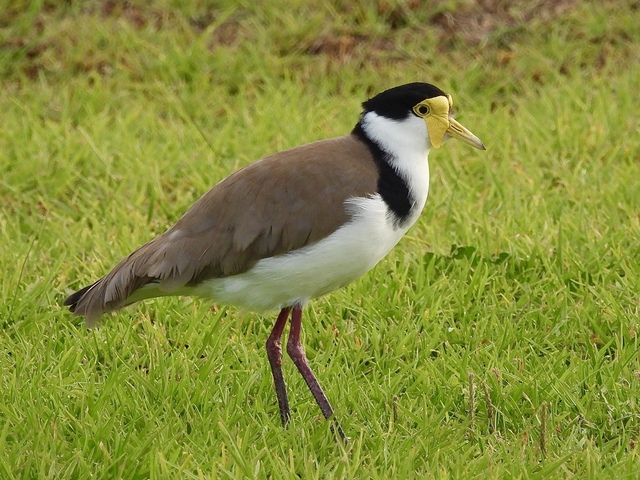
There are two widespread Australian lapwings, and both are seen on the Adelaide Plains and in the Mid North. The banded lapwing used to be called the banded plover, and the masked lapwing was the spur-winged plover.

Masked Lapwings do have a small sharp spur on the front of each wing (not always visible). Masked and banded lapwings have fleshy features called wattles.

Masked lapwings has a large yellow wattle on its face, and banded a small red one in front of its eyes.

They also have other things in common. Both are noisy with loud ringing calls, heard during the day and sometimes on calm, moonlit nights.

Their nests are a simple scrape on the ground, and three or four well camouflaged eggs are laid. After a long incubation of about a month, chicks hatch and can run soon after.

Adults vigorously defend their nest and young by swooping intruders. A broken wing act is also used as a distraction.

Masked lapwings are usually near water, fresh or salt. They are often seen in towns, and nest on any open area including football ovals.

Banded lapwings are mostly seen in farmers’ paddocks. They have declined in recent decades, but still occur in reasonable numbers around Bowmans and South Hummocks.

Although they tolerate dry conditions, in hot weather banded lapwings often congregate on undisturbed beaches around northern Gulf St. Vincent.

In my early days of farming, when fallowing was a general practice, this often coincided with the banded lapwing’s breeding season. I had to be on the lookout as this involved driving around nests of eggs.

Now with a lot of continuous cropping, some lapwings have adapted to nesting in recently emerged crops, with some success. Coincidentally, it just so happened that this change in cropping practice was around the same time as the change of name from plover to lapwing.

Digital Edition
Subscribe

Get an all ACCESS PASS to the News and your Digital Edition with an online subscription

Flinders Ranges submitted for World Heritage Bid

The Flinders Ranges, home to the earliest evidence of animal life dating back more than half a billion years, has been submitted for consideration...

More News

Applications open for the SATC Regional Event Fund

Organisers of new and existing events across South Australia are encouraged to apply for the South Australian Tourism Commission’s (SATC) Regional Event Fund 2026-27....

Eudunda Show Hall scores upgrade

Facilities at the Eudunda Show Hall are set for an upgrade, as one of four locally driven projects across the Mid North that has...

Babybels and Crows reveals: A grand Skilly wedding

A statue of little baby cheeses and a defection to the Pride of South Australia were two of many highlights at the wedding of...

Flood warnings issued for the Mid North

The Bureau of Meteorology has issued two flood warnings for the Mid North region as rainfall is expected to sweep across the state this...

Northern rural man charged with child sex offences

After an investigation, a northern rural man has been arrested and charged with child sex offences. On Thursday, 26 February, investigators from SA JACET, a...

Steele eyes sustainable future for Ngadjuri

The Animal Justice Party’s Candidate for Ngadjuri, Cherie Steele, is leading her election campaign with environmental advocacy, sustainable farming, and animal welfare. A secondary school...

Dividing door dollars awarded at Hamley

State Government funding will open doors for the Hamley Bridge Institute to be used to its full potential, through closing new soundproof doors which...

Police catch dangerous driver at Port Wakefield

A man has lost his car and will attend court at a later date after doing a burnout in Two Wells on Thursday afternoon. SAPOL...

Strong competition for Merino and crossbred lambs

SA LIVESTOCK EXCHANGE DUBLIN REPORT Sheep - 24 February Agents presented another mixed quality yarding as they offered 4200 lambs and 1000 sheep. The usual trade...

Gus Lamont parents appeal for info

The parents of four-year-old Gus Lamont, who disappeared from Oak Valley Station on 27 September, have appealed for public assistance as police investigations continue. Gus’s...