
With ANZAC Day approaching, many families across the Mid North have begun reflecting on the role their ancestors and family members played in supporting the war effort and stepping up for their nation.
In World War II alone 54,660 South Australians served, accounting for 43 per cent of eligible South Australians at the time.
The townships and communities across regional South Australia were a crucial part of this effort, whether it be through volunteers joining the fight directly as soldiers or through production efforts.
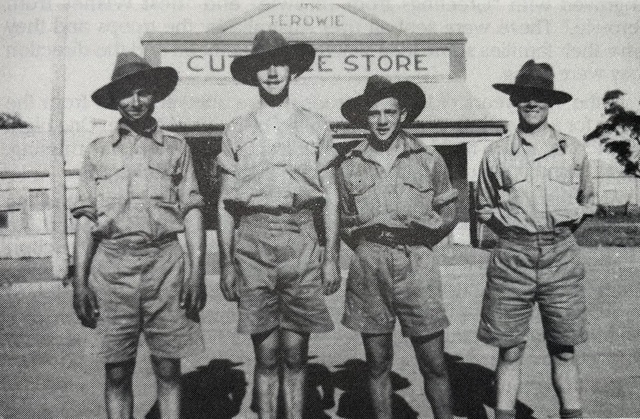
One such town who contributed in the best way they could was Terowie, which served as an army staging camp.
Terowie was at the junction of the old narrow gauge rail line which ran to Alice Springs and the broad gauge line linking the south to the north.
As the Pacific front opened following the Japanese forces’ attack on Pearl Harbor, the Australian Army turned its attention to defending the north, as such moving forces north-bound.
Getting to the north however, was a largely difficult task given the unmaintained condition of the track quashing any hopes of moving large quantities of supplies and men.
Hence, the narrow gauge line to Alice Springs became the prominent transport route to the north.
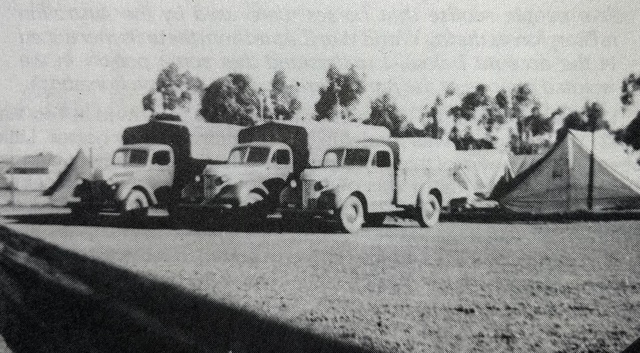
To facilitate the movement of men and materials, a military staging camp was established at the Terowie Oval, transfer platforms separate from civilian ones were built, alongside storage sheds for large ammunition stores.
There were several military personnel stationed permanently at Terowie, but for the majority of troops, only a brief portion of time was spent there.
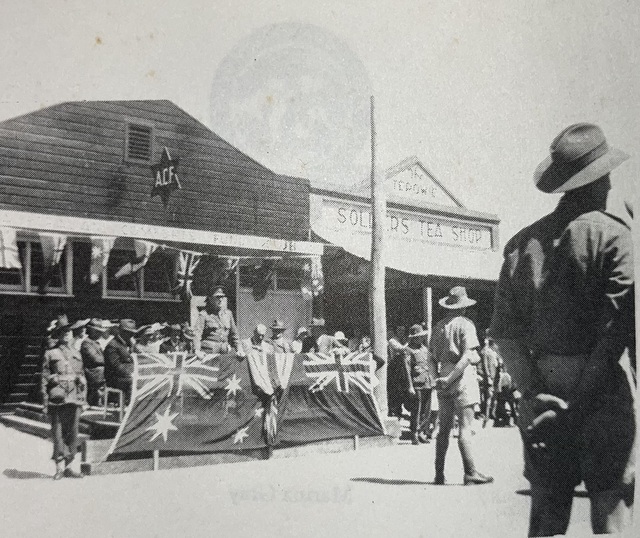
The townspeople of Terowie were heralded for their warm hospitality and everlasting efforts to raise morale by providing comorts and entertainment for the military personnel.
The camp was hastily established in 1940, following minimal if any consultation with the local council.
Two booklets courtesy of the Terowie Citizens Association detail numerous memoirs and diary entries from service members and locals of the time, titled ‘I Remember…’ and ‘I Remember Too.’
A repetitive theme across all recounts from those who served is the gruelling weather at the camp.
Many traded the tropics of Darwin for the bitter winters of Terowie as part of their stationing, with many soldiers detailing their accounts of nights by the fire at the YMCA Hall.
Others who graced the Terowie Staging Camp in the summer shar details of beating heat and chaotic dust storms, with many a meal complimented with the addition of red dirt.
Also prevalent in soldiers’ accounts is the water supply, which was overwhelmingly described as hard and less than ideal for bathing.
Numerous soldiers shared their grooming struggles, unable to run a comb through their hair following a wash.
Local woman Esme Kloss (nee Corcoran) detailed the camp’s establishment in the following recount.
“I was at home for a few days from my job at Tooralie Station, when some Army type vehicles drove into our town,” she said.
“Later one of our neigh-bours said there were some men in soldier’s uniform walking about the oval; they were dressed like officers.
That evening, just as it became dark, there was a roar of motors to the south, and my Mother suggested I climb up the windmill to look if I could see anything.
“I was nearly to the top rung when I heard a boy call, “Mum, you should see all the lights.” Then the neighbour called out, “Michael, get down off the roof the war is here!” I had climbed carefully up the rusty old mill but I was off it in a flash.”
Mrs Kloss described Terowie as a town always with no town water supply.
“Just imagine all those young men could not even have a shower. The Army soon got a bore put down in the oval (where the camp was established) but the water was so hard you would need a hack-saw to cut it — it was hard even to pour.
“Many young men were bald by the time they caught the narrow gauge train to Alice Springs.
Len Gosbell recalled the dry ground and dust was similar to a desert and the flies had nowhere to go apart from in their eyes.
“Ablution facilities left much to be desired, and the heat was greater than I experienced in Sydney. The palliasse of straw on a concrete floor was certainly not like home ……. all for six bob a day,” he said.
“Eventually the little train was available and away we went north. It struggled up the hills, and often soldiers would get off and walk alongside the train for a change.
“As well as giving a bit of much needed exercise to the aching muscles from the cramped conditions, it also lightened the load so as to make the poor old engine work a bit less.
B Bakewell of NSW recalled an unplanned and tumultuous encounter at Terowie when a routine training flight went awry.
After a mistake by the trainee navigator Mr Bakewell said the aircraft was running low on fuel and he decided to fire off a few distress flares.
“Luckily for us, someone at Terowie staging camp saw our distress signal and did something about it. There was immediate action,” he said.
“Two or three vehicles shone their lights, one along a fence line, one along a sort of creek, the pilot pulled had his landing lights on and suddenly… he pulled back the stick — blue streaks everywhere in our wireless compartment — I had lost my trailing aerial across some high tension wires but we landed safely.”
– Many thanks to Chris Kloss for providing the booklets and initiating this article.