
Andrew asked me to make a contribution to the Farming section for this week, while he enjoys a well deserved break. From time to time, I write an article here about birdlife.
I have spent most of my life getting out and about spotting birds. I have been fortunate enough to visit most parts of Australia and travel overseas, but most of my bird watching is done locally, in the Wakefield Regional Council (WRC) area.
This is quite a large LGA (Local Government Area), comprising cleared agricultural land with patches of mallee scrub, and some coastal vegetation near the shores of northern Gulf St. Vincent. I have seen more than 200 kinds of birds in the WRC area.
However, public places suitable for birdwatching are rather limited. Of these, I mainly go to Bald Hill Beach, Halbury and the Rocks Reserve. Some rare birds have been found at these spots, including a white-throated gerygone, which has been at “The Rocks” for the last month.
Sometimes, by just driving along back roads will result in finding a few birds. On these ornithological wanderings, I occasionally have a chat with local farmers.
As a retired farmer, the weather and how the season is shaping is a common topic. Now and then, birds are talked about, with mention of something interesting or unusual. I welcome these discussions.
I also greatly appreciate farmers that permit me to go on their property to see what birds are around. This can provide good insight into abundance and movements of birds in a particular area.
Winter is usually a fairly quiet season, although I have found a few interesting birds recently. This included a couple of spotted nightjars.
SPOTTING A NIGHTJAR
Some birds are just mostly found by chance. The Spotted Nightjar is one. As its name suggests, it is nocturnal, although not related to owls. There are three kinds of nightjars in Australia, and all are about 30 centimetres long.
Two occur on the east coast, and the other, the spotted nightjar, is found over most of the continent. It is regarded as moderately common in drier inland regions, but fairly rare on the Adelaide Plains. Here they are migratory, moving north through our area in autumn and early winter.
Spotted nightjars are so named because of a white spot in each of their long wings. As with other nocturnal birds, their flight is silent. They look like a hawk when flying.
Nightjars start hunting insects for food from dusk onwards, flying over clearings and by roadsides. You need to be fortunate to see one, but sometimes they rest on roads at night, and have a telltale red eye reflection in headlights. Unfortunately, this can end tragically. I have found deceased nightjars that have been hit by vehicles.
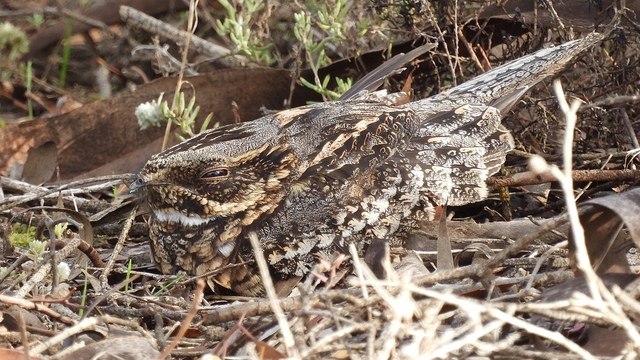
Finding a spotted nightjar during the day is a matter of pure luck. They are masters of camouflage, sitting motionless on the ground all day in scrubs among leaves and sticks. Their mottled grey and brown plumage matches the surroundings. Nightjars have large eyes, but they close them down to slits while roosting.
I came across two recently that were sitting on the ground during their normal daytime roost. These were at South Hummocks and near Balaklava. I almost stepped on one before seeing it. This is quite typical when finding one.
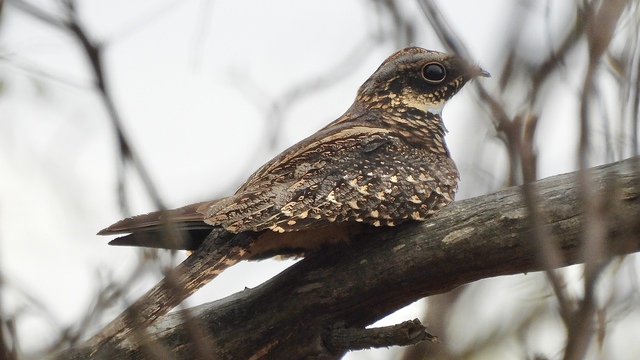
When flushed, they fly 50 or 100 metres through the scrub and settle on the ground again. Occasionally, one may land lengthwise on a horizontal branch. With luck, it might stay there long enough to manage a photo.
It is always special to see a spotted nightjar. Either by spotting one in the headlights while driving, or accidentally flushing one in a mallee scrub.