
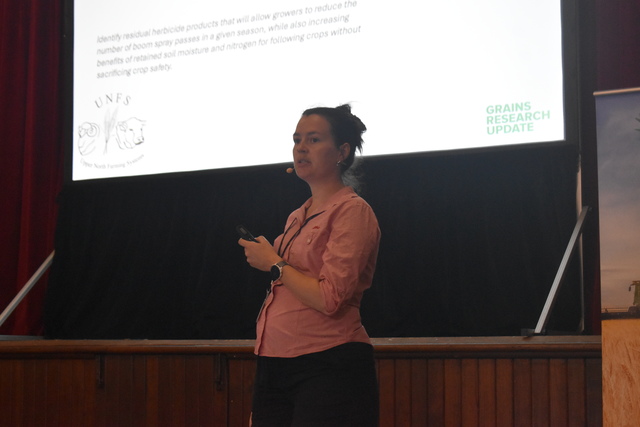
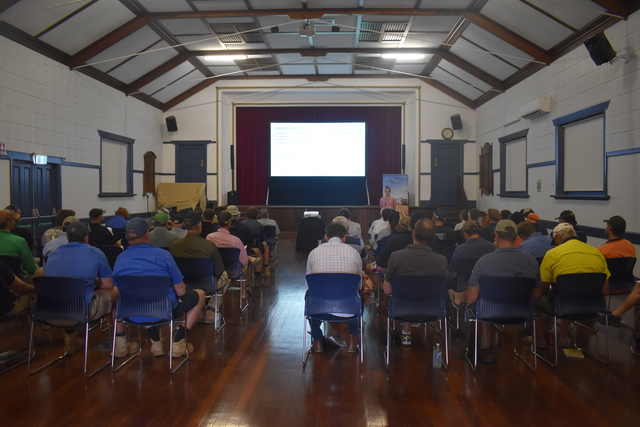
Mid North growers got a glimpse at the latest research to benefit their future crops at the Grains Research and Development Corporation’s (GRDC) Update event at Spalding District Hall on Thursday last week.
About 70 people were registered to attend the GRDC Grains Research Update, which aims to inform growers, advisors and researchers on the new and relevant information, and discuss the latest developments within the grain industry.
GRDC grower relations manager Rebekah Starick said the event at Spalding went really well, with a great attendance, with a good lineup of speakers covering topical issues and practical recommendations on what to do coming out of the 2024 season.
“Our whole mission is about generating enduring profitability for Australian grain growers, not only about what we can do today to create sustainable businesses, but what we can carry into the future to maintain those sustainable businesses,” he said.
Nicolas Dimopoulos from Southern Cross University was among the guest speakers at the Spalding Update, providing a talk on developing a better understanding of herbicide residues.
Mr Dimopoulos said there had been a lot of evidence which showed herbicidal damage past the plant back period, which is the recommended time after the use of herbicides for crops to be safely sown to avoid damage.
“The label assumes past a period of time it’s safe to plant, but growers find it’s not always the case, they’ve still got damage from herbicides well past what the label states,” he said.
“For the period past the label, it’s a black box, no one knows what is safe … what we’re trying to do is create tools so we’ve got more information on how to manage the crop.”
Mr Dimopoulos said the rate of herbicide breakdown was variable and depended on the environment of the soil in the paddock.
“An environment where it’s wet and warm will typically see herbicide breakdown faster than one where it’s dry and cold,” he said.
There is still a lot of research to be done on this subject, and Mr Dimopoulos said it would take another couple of years to fill the gaps.
This was the only study doing this research in Australia, and was involving Southern Cross University and the New South Wales Department of Primary Industries and Regional Development.
One presentation which had a bit of weight ahead of the new growing season came from South Australian Research and Development Institute (SARDI) researcher Blake Gontar, who talked about the hidden cost of root diseases.
Mr Gontar warned growers about the risks there might be in 2025 in terms of soil borne diseases, in particular two which were of particular concern, crown rot and rhizoctonia.
Crown rot is a fungal disease hosted by all winter crops and can survive for many years in infected plant residues, causing major yield losses when disease levels are high and there is moisture stress during grain fill.
Mr Gontar said crown rot had been increasing nationally, seeing similar trends in South Australia. He said the disease caused poor grain fill in the head if there was heat stress.
“This is key because in a wet season we get good infection but yield loss symptoms aren’t there, but if we get a dry finish, we do get those white heads,” he said.
“Growers often mistake that for frost, copper deficiency, different diseases … a lot of growers and agronomists don’t know they have an issue.”
Mr Gontar said 2022 had a big wet season, with a big crop, which was very good for crown rot infection, and two years on growers were about to dow again on that wheat stubble.
“We know we’re starting the year with minimal subsurface moisture, so the chance of moisture stress is very high so there’s an increased chance of yield loss from crown rot,“ he said.
Rhizoctonia is a root disease caused by a fungus, which grows on crop residues and soil organic matter, adapting to dry conditions and lower fertility soils.
This fungus causes damage by pruning newly emerged roots, with infection resulting in water and nutrient stress as the roots are compromised in their ability to translocate moisture and nutrients.
Mr Gontar said last season was perfect for rhizoctonia to build up and if the crop was going to be grown again on a paddock where the disease was present, it was likely to be at a high level because of the 2024 season’s condition, cold and dry.
Other guest speakers included Beth Humphris from Elders Jamestown who spoke about demonstrations of residual summer weed control for the Mid North, and Michael Eyres from Field Systems about dry sowing in the Mid North, and learnings from the lack of rainfall.
GRDC is next holding Updates across its Southern region in Bendigo on February 25 and 26, and then in Skipton on February 27. People are encouraged to keep up to date on GRDC research and events online at grdc.com.au