It was Mark Twain who originally coined this phrase (he later attributed it to someone else, but I digress) and it is still relevant today. As we move into another election, it pays to be mindful of some of the stuff that politicians trot out.
It would appear the media has been handed a number of interesting statistics to support their proposal to pave 5630 hectares of agricultural land in the state’s food bowl. One of the key stats is that this 5630 ha represents just 0.14 per cent of the state’s four million hectares which are cropped annually.
This is grossly misleading. What is of most importance is what percent they propose paving of the state’s highly productive farming country.
The four million hectares statistic includes vast tracts of marginal farming country, with minimal returns. What percentage might it be if we were to only include highly productive soils. An alarmingly high percentage, I expect.
Do not be seduced by statistics – they are often skewed to suit someone’s argument. Do your own homework.
Obviously, we need to increase urban land allocation because our population continues to climb, but for heaven’s sake, choose poorer performing soil, not the state’s most fertile soil.
Would not it have been so much smarter to plan new housing on poorer soils, such as west of Port Wakefield Road, instead of on all the good dirt at places like Roseworthy and Freeling?
Do not pave the dirt that feeds you.
Silo Birds – by Paul Taylor
In cereal growing areas there are silos and other grain storage facilities. Plenty of grain attracts plenty of pigeons.
These are not native birds, but were introduced into Australia from Europe. Formally known as rock doves (their original name), they are commonly called domestic pigeon, racing pigeon, homing pigeon or feral pigeon.
I prefer the last name. For the most part, especially around silos and farm buildings, they are pests. Their stick nests are messy, and they defecate everywhere.
All these feral pigeons often attract predators. Some birds like eating pigeons, particularly falcons.
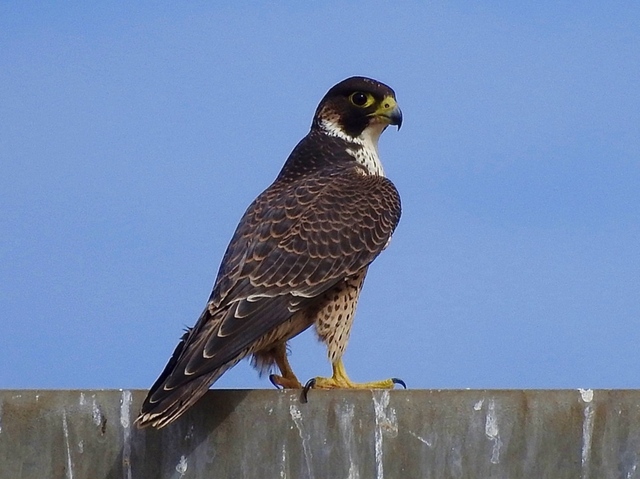
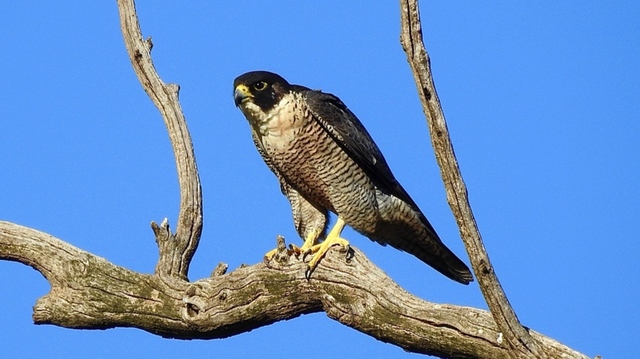
Around farm yards, I have seen black falcons preying on them. At silos, it is usually the peregrine falcon.
Peregrines are impressive looking birds, with their black head, fine bars underneath and bluish-grey back. They are powerfully built, although they are not much bigger than a pigeon.
The peregrine falcon is world famous. It is the most widely distributed bird of prey, being found on every continent (except Antarctica, of course).
It has the record of the fastest of all birds, and when diving after prey can reach speeds of over 300 km/h. Although worldwide, numbers are sparse in most countries.
In Australia, peregrines are generally uncommon. But with about one quarter of the world population, Australia is the stronghold for the species.
Locally, I have seen peregrine falcons at Owen, Balaklava and (the former) Mallala silos, and at Bowmans. A pair successfully nested at the Bowmans grain site a few years ago. No doubt there are peregrines at other silos in SA.
It is good to see peregrines preying on introduced birds like pigeons and starlings. Of course, they also eat other birds, like galahs and parrots.
But silos are a favoured hunting ground, and a pigeon certainly provides a good-sized meal. Unfortunately, they do not make much of a dent in the feral pigeon population.
My suggestion for silo art would be a painting of a giant peregrine falcon, in recognition of its feral eradication service. Such a mural may, temporarily, even scare away the pigeons.
(Ed: Great idea! Let’s paint a Peregrine Falcon on one of the remaining Viterra silos. I believe there is a resident pair at the Owen silos at present and the pigeons appear to have moved on … probably to my hay shed and workshop.)