A contingent of Mid North agricultural innovators and leaders have been named as finalists for an upcoming awards ceremony.
Six Mid North locals were announced on 1 December as finalists for the 2025 South Australian Grain Industry Awards, hosted by Grains producers SA (GPSA).
The Awards, which celebrate the industry’s exceptional leaders and recognise their efforts in 2025, will be held at Adelaide Oval on 3 February, between the Grains Research and Development Corporation (GRDC) Update.
Marrabel grower Kym I’Anson is a finalist for the Innovation Award, recognising his long-term contribution to the industry through his involvement in soil pH mapping, amongst other things.
“We’ve always been aware of the latest technology, and despite being a smaller farm, we have always implemented it and tried to develop it further,” he said.
“When you get a lot of new technologies, they’re very immature, and you generally can’t use them across the cropping system, but if a few people embrace it you can develop them.
“With precision agriculture, there’s a lot of areas that we’ve specialised in as well, and not just individually, but with a lot of other people.”
Mr I’Anson said farming could be very individual but at the same time, there was a big goal of developing new ideas and sharing those to allow others to be as profitable as possible.
“We can’t do this job on our own, and we want to help each other as much as we can,” he said.
Mr I’Anson has been involved with pH soil mapping since its infancy, and after a slow uptake the process has become an integral part of the industry, improving the profitability of pulses.
“It’s helped ourselves and other growers to more reliably grow a pulse in the system, which just creates a more sustainable farming system,” he said.
“We want to promote ourselves to, not just other farmers, but to our urban counterparts as well.
“A big part of pH testing is not just to find out where you need to spread alignments, it’s about creating variable maps and applying our inputs which are expensive and in limited supply, and just putting them where they’re most needed most.
“If you can be a lot smarter about where you’re applying your inputs, you’re reducing your impact on the environment in general.”
Jamestown grower Holly Crawford was named as a finalist for the Sustainability Award but said she could not take sole credit for the work her wider family have partaken.
“I definitely see it as a team effort, we’re a family farming business, and my father in law, Trevor was a catalyst for farming the way we do now,” she said.
“My husband Luke is the driving force behind everything we have done as well.”
The Crawford family has undertaken a range of sustainably conscious trials on their operation, dating back to the early 2000s, where Trevor built his own disc seeder to plant feed without disturbing the soil.
Ms Crawford said as they continually made improvements over time, they noticed benefits in terms of soil protection and erosion prevention.
“We really focus on soil biology, using low chemical inputs as much as possible, and gradually over the years integrating compost and natural fertilisers to replace synthetics,” she said.
“It’s definitely exciting to see progress, when we first switched away from synthetics, Luke noticed immediately an increase in earthworms in the soil.
“That’s what we’re focused on in all facets of farming, improving soil health and in turn improving plant health, so that biology can work for us by providing nutrients we would otherwise supply synthetically.”
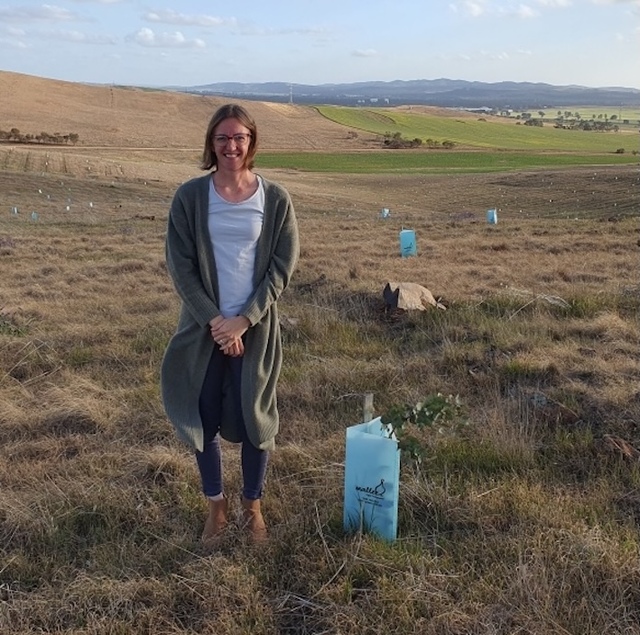
Another major initiative undertaken by the Crawfords is the 2023 revegetation project as part of the Carbon+ Biodiversity Pilot, with the aim to plant biodiverse species to create habitat and to be a carbon sequestration activity.
Ms Crawford said the plants were growing nicely despite the challenging conditions, and like many other projects it was a work in progress.
“We definitely don’t have it perfect, for example on the cropping side of things but we are continually trialling, learning, and improving the way we do things,” she said.
“The other part of sustainability is the money, so that’s another area we are always exploring.”
The Crawfords have recently started a harvest partnership with a neighbouring farmer with an operation of many similar facets to counter rising financial pressures, forming part of their efforts to increase sustainability on the financial side.
Ms Crawford said they had also undertaken greenhouse gas emission accounting, in what has been an interesting exercise, comparing what they produce with their carbon output.