
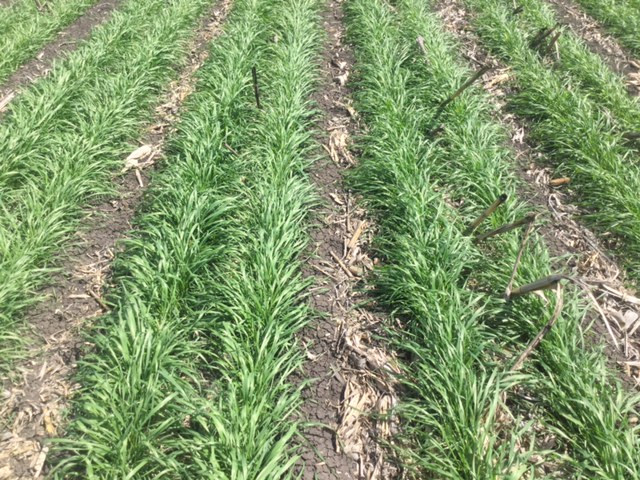
Grain production across the state is on track to exceed last year’s harvest, per a State Government report released recently.
The latest Crop and Pasture Report, published by the Department of Primary Industries and Regions (PIRSA), forecasts an encouraging start to the 2026-27 season, with favourable weather and soil conditions appearing to offset concerns about the impact of international conflicts on the cost and supply of fuel and fertiliser.
Grain production is tracking towards nine million tonnes and yield potential looks likely to approach the 10-year average, with preliminary estimates pointing to a higher total cropped area than last season as improved stored soil moisture enables increased planting.
Early May rainfall supported strong planting programs and provided better conditions for pre-emergent herbicide activities.
Further rains will be necessary to maintain persistent pastures, and supplementary feeding will continue to be important for farmers in some areas to better manage their recovery from previous dry conditions.
Lentils have firmly established as South Australia’s third largest crop by area, behind wheat and barley, and are expected to increase by a further 12 per cent compared to 2025-26. Interest in canola is steady where moisture has allowed timely sowing.
It was reported that the Upper North, Mid North, and Lower North regions had respective estimated crop yields of 441,500, 434,300, and 117,340 hectares, or 842,290, 1.14 million, and 368,571 tonnes.
PIRSA estimated in their post-2025 season report that the Upper North produced 414,500ha or 948,240 tonnes, and 408,200ha or 186,190 tonnes in 2024.
The Mid North was estimated at 416,900ha and 569,550 tonnes for 2024, and 429,200ha and 1.04 million tonnes for 2025, while the Lower North was estimated at 117,840ha or 225,554t for 2024, and 118,340ha or 339,836t for 2025.
Livestock has benefited from better pasture growth and feed availability following recent rainfall, fuelling a return to near-average feed on offer for many areas.
Improved livestock conditions are offering welcome additional relief for many farmers still recovering from drought.
Minister for Primary Industries and Regional Development Clare Scriven MLC said it was an encouraging start to the season for South Australian grain and livestock producers, with early rainfall and strong planting activity helping set up many regions for the months ahead.
“It is particularly pleasing to see increased cropped area across the State and continued growth in lentil production, which reflects both producer confidence and the strength of South Australia’s agricultural sector,” she said.
“While our producers continue to face challenges, particularly in relation to weather conditions and global uncertainty, these early indicators are positive and highlight the resilience and adaptability of South Australian producers.”
Grain Producers SA chief executive officer Brad Perry said after some incredibly tough seasons, South Australian grain producers would welcome a far more positive start to this year’s cropping program.
“Having moisture in the profile is a significant improvement on where many growers have found themselves in recent years, but there is no doubt farmers aren’t taking anything for granted in May,” he said.
An early nine-million-tonne forecast is encouraging, but as we know, the season still has plenty of hurdles to navigate, from rainfall and frost risk through to the continued instability of global fuel and fertiliser pressures and lower than anticipated grain prices.
“It’s particularly pleasing to see continued confidence in lentils, which have become an increasingly important part of South Australian grain production systems.”
The PIRSA Crop and Pasture Report provides industry and the Government with key intelligence on regional grain and pasture performance across 14 districts in South Australia.
The report includes a statewide summary of crop conditions, paddock activities, seasonal weather impacts, livestock condition, pasture performance and feed availability.
The full report is available online at pir.sa.gov.au/crop-report